
Week 2: Strengthen The Community
Opening Questions
What stood out most to you from the daily Scripture readings this week? Did you learn anything new? Did you have questions? Did you gain insight to share with the group?
Jesus unites a group of infinitely unique people. Think about your family background and life experiences. What would be 5-10 characteristics, relationships, accomplishments, key events, etc. that have shaped who you are? Share several things from your list with the group.
Watch the Video Below
Reflection
In the very beginning, God walked with Adam and Eve in the Garden of Eden. Then sin entered the world and a great chasm opened up between them. Yet, throughout the Old Testament, we see God continuing to approach His people in different forms—as a voice, in a dream, through an angelic visitor, and even a burning bush. After Moses leads the Israelites out of captivity in Egypt, God’s presence dwells with them in a tabernacle that they repeatedly disassemble and move with them as they wander in the desert. Later, King Solomon oversees the building of a permanent temple in Jerusalem, a physical place where people can go to be in the presence of God.
But in those days not all people were offered equal access to God. In the temple in Jerusalem, the divide between Jews and Gentiles was dramatic. Gentile worshippers were confined to the outermost courts, which also happened to be the location of the temple marketplace. A modern equivalent would be something between a livestock auction and the New York stock exchange. Not exactly a worshipful environment.
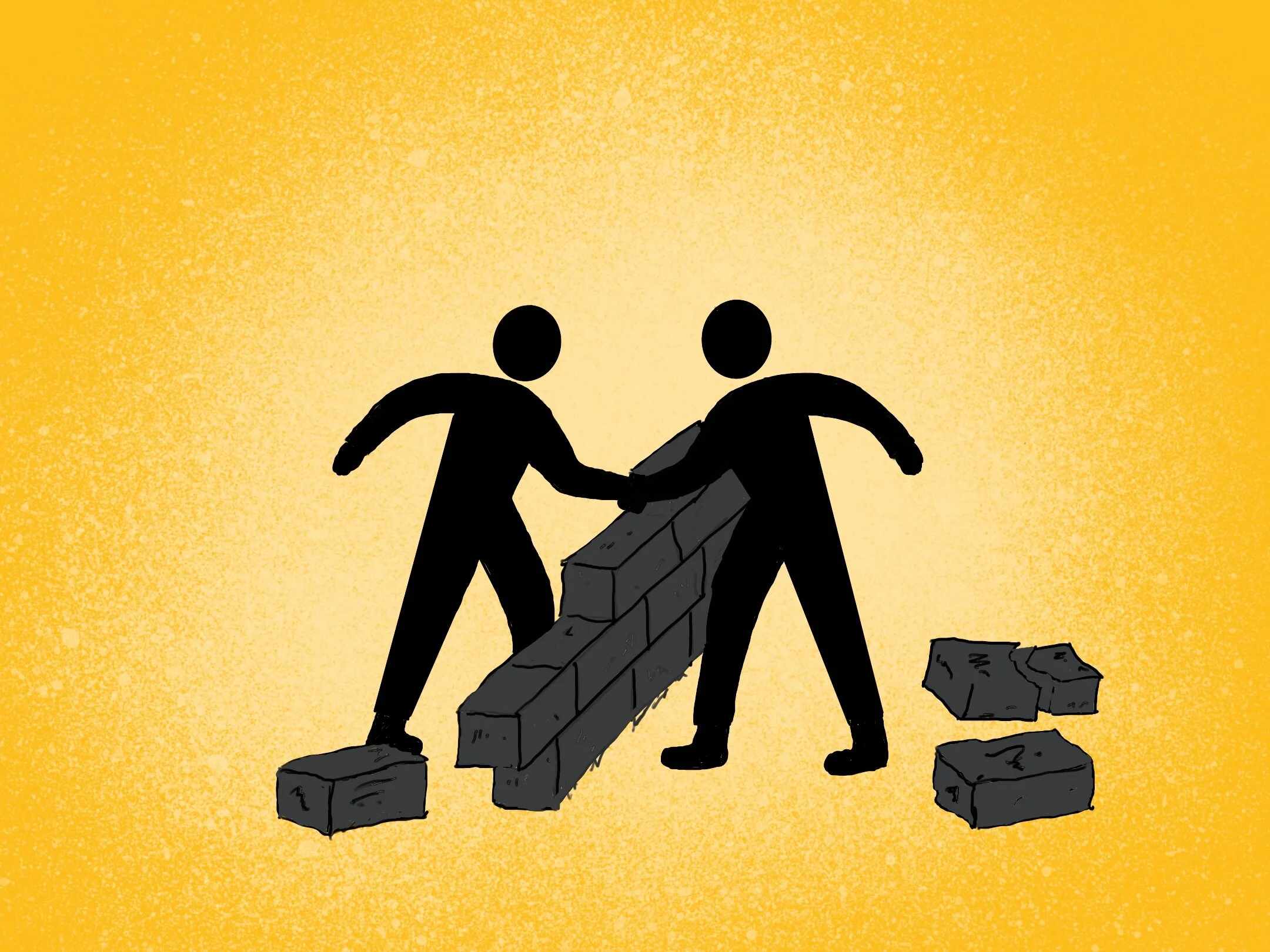
It was into this ‘den of robbers’ that Jesus entered in the week leading up to His crucifixion. Here we see Him cracking a whip and throwing tables, condemning the abuse of power and reminding the Jewish leaders of Isaiah 56:7, “My house will be called a house of prayer for all nations.” Jesus makes it clear that God intends to reach all people. He intends to reconcile man to Himself, and to his fellow man.
After His death and resurrection, Jesus’s disciples become the new temple. Strangers and aliens become fellow-citizens, fitted together in Jesus. We who were once separated, defined by our differences, become one in Him.
And together, we show God to the world.
It is something like a mosaic. We are each a unique representation of the work and power of God in a human life. On close inspection, someone viewing the mosaic can see the individual pictures, that we are each beautiful in our own way. But the clearest representation of God is seen from a distance, when all of the pictures merge into a larger image of Love.
We, as the church, are called to carry God’s love into the world. But imagine what happens when His image is tarnished with the red overtones of our anger or the blackness of our hate. Or what it does to His image when our place in the mosaic shows up blank because we choose to withdraw our participation from the church altogether.
Our unity is important. 1 Peter 2:1 warns us, “… rid yourselves of all malice and all deceit, hypocrisy, envy, and slander of every kind.” For the eyes of the world will be drawn to our flaws. They will focus on the blank spaces, the anger, the division, and the hatred and miss the overall picture.
But unity is not our goal. Our goal is to follow Jesus—who gives us the power to live in unity. Just before He was crucified, Jesus prayed for unity among His followers: “My prayer is not for them alone. I pray also for those who will believe in me through their message, that all of them may be one, Father, just as you are in me and I am in you. May they also be in us so that the world may believe that you have sent me. I have given them the glory that you gave me, that they may be one as we are one—I in them and you in me—so that they may be brought to complete unity. Then the world will know that you sent me and have loved them even as you have loved me.” (John 17:20-23)
Notice that Jesus was praying not just for the twelve disciples who were with Him, but for all who would believe in Him. Because Jesus prayed for unity among all believers—past, present, and future—Jesus prayed for us.
Which gives us hope that we can do things we could never ask or imagine.
Reflection
Strong individuals make strong communities.
“Imagine yourself as a living house. God comes in to rebuild that house. At first, perhaps, you can understand what He is doing. He is getting the drains right and stopping the leaks in the roof and so on; you knew that those jobs needed doing and so you are not surprised. But presently He starts knocking the house about in a way that hurts abominably and does not seem to make any sense. What on earth is He up to? The explanation is that He is building quite a different house from the one you thought of - throwing out a new wing here, putting on an extra floor there, running up towers, making courtyards. You thought you were being made into a decent little cottage: but He is building a palace. He intends to come and live in it Himself.”
C.S. Lewis, Mere Christianity
In what ways are you cooperating with God’s building plan for your life? Are there any areas in which you are fighting the remodeling process?
Strong communities make strong Individuals.
“I will be with you. I welcome you to be with me. It is in your being with me that I come to know who I am and it is in our being together that it is possible to know who He is who has the power to change us both.”
Elizabeth O’Connor, Inward Journey, Outward Journey
How have you been strengthened or encouraged by your community?
Practicing Community: Offer Presence
In Old Testament times, the temple in Jerusalem was divided into various sections, separating people groups. The Gentile Court was the outermost section of the temple compound. Gentiles who came to worship God were restricted to this section. Continuing toward the center of the temple grounds, the next designated area was the Women’s Court, beyond which only Jewish men could proceed. Only men from the tribe of Levi could continue on into the Holy Place. And finally, only the high priest could enter once a year into the centermost chamber of the Holy of Holies.
But God removed all of the barriers through Jesus. When Jesus died, the curtain separating the Holy of Holies tore in two from top to bottom, giving every person direct access to the Father. Our relational God restored us to Himself, and He now intends for us to offer community and fellowship to each other.
Next Steps
How might God be inviting you into deeper community? How do you want to respond?
How can this group support you? End your meeting in prayer for each other.